
When the Workflow Changes, What's Left?
The rituals are changing. Do you know what's actually yours?

A lot of people are about to discover they've been describing themselves in workflow language.
To understand why, it helps to think about what most of our work actually is:
Infrastructure — the systems and platforms everything runs on
Workflows — the processes and rituals that coordinate how work gets done
Judgment — the calls people make about what to build, what to prioritize, and what "good" looks like
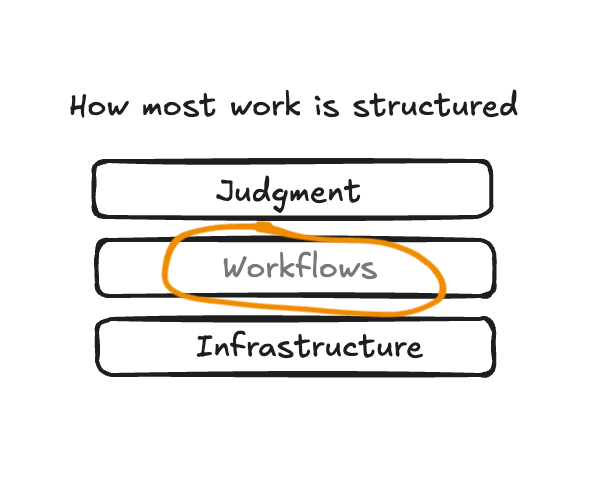
What I’m watching collapse right now is the middle layer. The workflows.
Take project management tools. Jira is the obvious example, but this applies broadly. These tools were built to solve a specific problem: execution was the hard, slow, expensive part of building software. You needed somewhere to track what was left, who owned what, how confident you were shipping on time. Tickets, sprints, status updates, standups — the whole ritual existed because the gap between “we decided to build this” and “this is shipped” was long and unpredictable. The workflow was a coordination layer for that gap.
That gap is compressing. Not closed — but compressing.
This is my read on what’s happening to project management software — not that someone will rebuild Jira with Claude Code (though they will), but that the teams who used to live in Jira are starting to work differently. The rituals are breaking. Not replaced by something cleaner. Just no longer the thing holding everything together.
What replaces them? I genuinely don’t know, and I don’t think anyone does yet. I’m watching engineering teams run experiments in real time — some dropping sprint ceremonies entirely, some delegating all of that to agents, some running hybrid systems that don’t have a name, some moving toward no tickets or fewer tickets and more principles. None of these is the new workflow. They’re all mid-renegotiation.
What’s collapsing is the middle — the part that touches how people actually spend their days.
Think about what Jira-era work actually required: knowing how to break down a project into tickets, managing sprint ceremonies, keeping status visible to stakeholders. Those skills were real. But Jira taught you what to value, what to measure, what "good" looked like. Take Jira away, and a lot of people discover they've been describing themselves in workflow language:
“I run sprints.” “I manage delivery.” “I keep teams aligned.”
Those are true — but they’re descriptions of the coordination layer, not of the judgment underneath it.
The judgment is the part that travels. The ability to read where work is actually stuck. To know when alignment is real versus performed. To make a call with incomplete information. None of that lives in Jira. It never did. But Jira gave it a shape, and now that shape is changing.
How much of your role was shaped by a workflow that’s now shifting? What’s actually yours?
Not the sprint ceremony. Not the status update. The judgment you developed while doing all of it.
That part doesn’t expire. But you have to be able to see it separately first.